English
Anode Material Guide: Purity Grades, Metals and Sourcing Checks for Cells
Content
- 1 Anode Material: One Term, Three Different Spec Sheets
- 2 Where Metal Actually Sits Inside a Lithium-Ion Anode
- 3 Purity Grades: What 3N, 4N and 5N Actually Promise
- 4 Titanium and Niobium: The Metals Behind High-Rate Anodes
- 5 Tantalum and Niobium Anode Materials in Capacitors
- 6 A Procurement Checklist That Prevents Lot Rejections
- 7 Frequently Asked Questions About Anode Material
A purchasing engineer signs off on a 300 kg lot of copper foil. Two days later it fails incoming inspection: iron at 18 ppm against a 10 ppm ceiling, oxygen at 22 ppm against 8 ppm. On the certificate the material is 99.99% pure. It still cannot go onto the coating line.
That gap between the grade printed on a document and the impurity profile that actually arrives at the plant is the whole problem in anode material sourcing. The conclusion first: for anode-side metals, the number that decides yield is not the headline purity percentage. It is the individual trace-element limits, the analytical method used to confirm them, and the process control that keeps them stable from lot to lot.
What follows covers where ultra-high-purity metals sit in lithium-ion cells, electrochemical anodes and electrolytic capacitors, which grades are realistic for each, and the checks that stop a qualified material from drifting out of spec.
Anode Material: One Term, Three Different Spec Sheets
Ask five engineers to define anode material and you will collect at least three answers, each attached to a different purchase order. The word describes a function, not a material class. Buying against the wrong definition is one of the more expensive mistakes in this category, because a specification written for a capacitor anode says almost nothing about a battery current collector.
- Battery anode active material — graphite, hard carbon, silicon-carbon composites, lithium titanate (LTO) and titanium niobium oxide (TiNb2O7). Purity requirements apply to the metal precursors, not to a finished metal part.
- Electrochemical anodes — titanium sheet, mesh or tube carrying a mixed-metal-oxide coating, used in electroplating, cathodic protection, water treatment and chlor-alkali service. What matters is substrate purity, flatness and coating adhesion.
- Capacitor anodes — sintered tantalum or niobium powder bodies inside solid electrolytic capacitors. The metrics are capacitance per gram, oxygen and carbon content, and shrinkage during sintering.
| Anode category | Base metal or material | What buyers test | Typical failure mode |
|---|---|---|---|
| Battery active material | Graphite, hard carbon, silicon, LTO, TiNb2O7 | Particle size, tap density, first-cycle efficiency | Capacity fade, gas generation |
| Current collector | Copper foil, nickel, titanium mesh | Resistivity, oxygen content, thickness tolerance | Pinholes, coating delamination |
| Electrochemical anode | Titanium Grade 1 or 2 with MMO coating | Substrate flatness, coating loading | Coating spall, passivation |
| Capacitor anode | Tantalum and niobium powder | CV/g, oxygen and carbon content, shrinkage | High leakage current, low capacitance |
Where Metal Actually Sits Inside a Lithium-Ion Anode
In a commercial lithium-ion cell the active material is carbon or a carbon-silicon blend. The metal is everything around it, and it is specified just as tightly.
The anode current collector is copper foil, normally 6 to 9 µm thick, with high-energy designs pushing toward 4.5 to 6 µm. At that gauge the foil is usually specified at 4N (99.99%) with oxygen held below 5 to 8 ppm and individual elements such as iron and sulfur capped in the low single digits. A lot that meets a total-impurity limit while carrying 15 ppm of iron will still etch into pinholes, lose adhesion at the coating interface and tear along the edges during winding.
Nickel appears in tabs, in nickel-plated copper and in specialty foils for high-temperature cells. Titanium appears as mesh, felt or sheet when corrosion resistance matters more than conductivity — for example in electrodes running in acidic electrolytes or in electrolytic cells where the same titanium part acts as a working anode.
Thin-film and solid-state development adds a vacuum step. Copper sputtering targets used to deposit seed and current-collector layers are judged on target purity, grain size and oxygen content, because those variables drive film resistivity and particle generation on the substrate.
 High-Purity Copper Sputtering Targets for PVD Thin FilmsHigh-purity copper sputtering targets for PVD seed and current-collector layers, offering 99.999–99.9999% purity and customizable dimensions for coating equipment.View Product →
Demand for these materials is concentrated in a handful of new-energy applications, where a single out-of-spec element can idle a coating line for a full shift.
- LTO spinel anode
- Graphite anode
- Silicon-dominant composite
Chart: illustrative capacity retention over 1,000 cycles, indexed to 100% at cycle one. Y-axis: retention in percent.
Purity Grades: What 3N, 4N and 5N Actually Promise
A purity grade is shorthand for a total impurity ceiling, and the shorthand hides differences of a hundredfold.
- 3N means 99.9% metal, or up to 1,000 ppm of everything else.
- 3N5 means 99.95%, up to 500 ppm.
- 4N means 99.99%, up to 100 ppm.
- 4N5 means 99.995%, up to 50 ppm.
- 5N means 99.999%, up to 10 ppm.
The trap is that a 4N certificate only promises the total stays under 100 ppm. A lot carrying 60 ppm iron, 20 ppm oxygen and 15 ppm sulfur satisfies 4N and is still unusable for thin copper foil. Anode-side procurement therefore needs element-specific limits plus a statement of the analytical method behind each number.
ICP-OES handles routine trace metals down to roughly 1 ppm. ICP-MS reaches into the ppb range and is the usual tool for 4N5 and above. Glow discharge mass spectrometry verifies 5N material, while combustion techniques measure oxygen, nitrogen, hydrogen, carbon and sulfur — the interstitial elements that standard trace-metal panels ignore entirely.
| Grade | Nominal purity | Total impurity ceiling | Typical anode-side use | Verification method |
|---|---|---|---|---|
| 3N | 99.9% | 1,000 ppm | Industrial electrochemical anodes | ICP-OES |
| 3N5 | 99.95% | 500 ppm | Niobium oxide feedstock | ICP-MS |
| 4N | 99.99% | 100 ppm | Copper current collector foil, targets | ICP-MS plus combustion |
| 4N5 | 99.995% | 50 ppm | Titanium and niobium for high-rate anodes | ICP-MS plus GDMS |
| 5N | 99.999% | 10 ppm | Research cells, thin-film anodes | GDMS |
Titanium and Niobium: The Metals Behind High-Rate Anodes
Two chemistries trade energy density for rate capability and cycle life, and both depend on titanium and niobium: lithium titanate (Li4Ti5O12, known as LTO) and titanium niobium oxide (TiNb2O7), plus the simpler niobium pentoxide route.
LTO is a spinel with a flat 1.55 V plateau, around 175 mAh/g of practical capacity and near-zero lattice strain, which is why it survives tens of thousands of cycles. Its precursor — titanium dioxide or titanium powder — has to hold iron, niobium and residual alkali metals at low levels, because those impurities sit in the spinel lattice and raise impedance.
Niobium pentoxide delivers roughly 180 to 200 mAh/g with a safe operating window and strong rate performance. TiNb2O7 goes further, with a theoretical capacity near 387 mAh/g, but it consumes both metals and demands consistent oxygen control in the niobium feedstock. The practical supply chain runs from niobium ingot through hydriding and milling to powder and oxide, so the purity of the ingot sets the floor for everything downstream. Understanding niobium's role in high-technology industries helps explain why 3N5 and 4N niobium carry a price premium over ordinary ferroalloy grades.
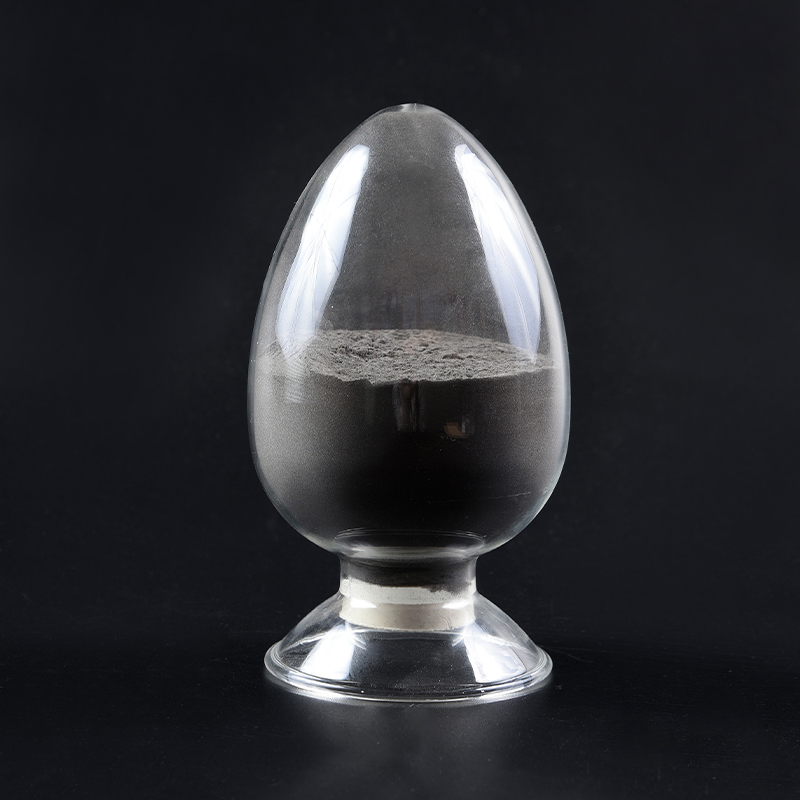 High-Purity Titanium Powder for AM, MIM, and Sputtering TargetsHigh-purity titanium powder for additive manufacturing, MIM, and sputtering targets, with customizable particle sizes and 99.8–99.99% purity for advanced manufacturing.View Product →
Chart: practical reversible capacity in commercial cells, mAh/g. Values are typical, not guaranteed, and depend on cell design and electrode formulation.
Tantalum and Niobium Anode Materials in Capacitors
In a solid electrolytic capacitor the anode is a porous sintered pellet of tantalum powder, which means the powder is the component. A typical specification calls for 99.95% to 99.99% tantalum, oxygen controlled within a defined band, carbon held low, and an agreed particle size distribution and Scott density. Buyers compare capacitance per gram, shrinkage after sintering and leakage current in the finished part, not a single purity figure.
Niobium and niobium oxide anodes are the lower-cost alternative. Niobium is roughly half as dense as tantalum, so fewer grams are needed per part, and oxide anodes are more forgiving in high-temperature reflow. The trade-off is tighter oxygen control during sintering, because excess oxygen converts into leakage current. Whichever route a capacitor maker chooses, it starts with high-purity ingot that is converted into powder, and the ingot's interstitial profile follows the powder all the way to the finished anode.
 High-Purity Niobium Ingot for Semiconductors and SuperalloysHigh-purity 99.99% niobium ingot for semiconductor sputtering targets, crucibles, superalloys, and superconducting alloys, with dimensions up to 400 mm and 2 metric tons.View Product →
A Procurement Checklist That Prevents Lot Rejections
Most anode-metal disputes trace back to a specification that was written around a percentage instead of around a failure mode. Eight items close that gap.
- Write element-specific limits for iron, nickel, chromium, sulfur and chloride, not only a total impurity ceiling.
- Name the analytical method and the detection limit required for each element.
- Specify interstitial elements — oxygen, nitrogen, hydrogen, carbon and sulfur — for copper, titanium and niobium.
- Set dimensional tolerances separately: thickness within plus or minus 5%, plus width, camber and surface roughness where relevant.
- For powders, require particle size distribution, Scott density and oxygen content on every certificate.
- Require a per-lot certificate of analysis traceable to a heat, melt or ingot number.
- Confirm the process route — electrolysis, vacuum induction melting, electron beam melting or vacuum arc remelting each leave a different residual signature.
- Check the quality system: ISO9001 as a baseline, IATF16949 if the material feeds an automotive battery programme, and agree on packaging and shelf life because titanium and niobium surfaces pick up oxygen in storage.
- Purity out of spec — 38%
- Surface and edge defects — 24%
- Dimensional tolerance — 20%
- Documentation gaps — 18%
Chart: typical distribution of anode-metal rejections found at incoming inspection.
Frequently Asked Questions About Anode Material
Is a higher purity grade always better for anode material?
No. Grade answers a total-impurity question; the failure mode usually depends on one or two elements. A 4N copper with oxygen held below 5 ppm will outperform a nominal 5N copper with unstable oxygen and sulfur, because pinholes and adhesion loss are driven by those specific elements rather than by the total.
What is the practical difference between 4N and 4N5 copper?
Roughly a factor of two in the total impurity ceiling: 100 ppm against 50 ppm. For foils thinner than 6 µm, that difference often decides whether an incoming lot passes, because the same absolute iron level produces a larger share of the foil's cross-section as thickness falls.
Which metal is used for the anode current collector?
Copper in almost every lithium-ion design, nickel-plated copper for tabs, and titanium mesh or sheet where corrosion resistance outweighs conductivity. Graphite active material sits on top; the metal underneath still has to hold its resistivity and its surface quality through coating, drying, calendering and winding.
How is purity verified on a delivered lot?
Through a per-lot certificate of analysis based on ICP-MS or ICP-OES for trace metals and combustion analysis for oxygen, nitrogen, hydrogen, carbon and sulfur, plus an independent check on retained samples. Suppliers that offer a dedicated purity testing service make that verification step considerably shorter.
Ningbo Chuangrun New Materials has been purifying, melting, casting and processing ultra-high-purity metals since 2012, operating from five production bases with a team of around 40 metallurgy professionals and more than 60 registered technology patents. The product range covers titanium, nickel, copper, niobium, cobalt, tantalum, molybdenum and alloys in crystal, ingot, powder, sponge, plate, rod, tube and target forms, supported by ISO9001 and IATF16949 quality systems and a dedicated purity testing service.
If you are specifying anode-side metals and want the element-by-element impurity profile confirmed before shipment rather than after, send the specification to the team and ask for a lot-level analysis against your own limits.