English
Alloy Properties Explained: Composition, Purity, and How to Specify Them
Content
Two suppliers can ship the same grade, whether that is TC4 or 6061-T6, and only one of them will pass your fatigue test. Nothing on the certificate looks wrong. The grade did not change; the properties did, because properties come from composition, microstructure and processing history together, and a purchase order that names only the grade controls roughly a third of that.
The working rule is straightforward: alloy properties are a specification you define and verify, not a label you inherit. What follows covers where those properties come from, which numbers matter in which service condition, and how to write them into an order so that two suppliers deliver the same material.
Where Alloy Properties Come From
A pure metal is soft and conductive for one structural reason. Its atoms sit in an orderly lattice held together by metallic bonding, and the electrons that hold that lattice together are also free to move. Dislocations slip through the lattice with little resistance, which is why annealed copper is soft and why pure metals carry heat and current so well.
Adding a second element disturbs that lattice in two different ways, and the difference shows up in service rather than in a textbook.
| Aspect | Substitutional solid solution | Interstitial solid solution |
|---|---|---|
| Mechanism | Solute atoms replace host atoms on lattice sites, usually with similar atomic radius | Small atoms sit in the gaps between host atoms |
| Typical systems | Copper-nickel, brass (Cu-Zn), stainless steel (Fe-Cr-Ni) | Carbon in steel, nitrogen in stainless steel, oxygen in titanium |
| Property effect | Moderate strengthening with ductility largely retained; also shifts conductivity, colour and corrosion behaviour | Strong strengthening per unit of addition; the fastest route to losing ductility |
| Main risk | Large additions are needed before strength moves much | A few hundredths of a percent too much causes embrittlement |
Two further factors decide the numbers printed on the certificate. Crystal structure sets how many slip systems are available: face-centred cubic metals such as aluminium, copper and nickel stay ductile to low temperatures, body-centred cubic metals such as ferritic steel show a ductile-to-brittle transition, and hexagonal metals such as titanium slip on fewer planes and carry that directionality into the finished part. Processing then writes the final value, since the same steel quenched and furnace-cooled differs by hundreds of megapascals.
Indicative minimum tensile strengths. Dark bars: commercially pure metal. Gold bars: the alloyed or heat-treated version of the same base metal. Values shift with product form, thickness and condition.
Which Property Family Are You Actually Buying?
Alloy properties is a category, not a value. Buyers and engineers often argue past each other because each side is verifying a different family. This table maps the families to the evidence that confirms them.
| Property family | What it answers | How it is verified | Where specifications go wrong |
|---|---|---|---|
| Mechanical | Strength, hardness, ductility, toughness, fatigue life | Tensile test, hardness survey, impact and fatigue testing | A single hardness number quoted without a heat-treat condition |
| Physical | Density, electrical and thermal conductivity, magnetic response, expansion | Four-point probe, thermal diffusivity, dilatometry | Conductivity quoted for a different purity or temper than the one shipped |
| Chemical | Corrosion and oxidation resistance, ion release | Salt spray, electrochemical testing, high-temperature oxidation runs | A laboratory medium that does not resemble the real service medium |
| Thermal and high temperature | Creep, stress-rupture life, strength retention at temperature | Creep and stress-rupture testing | Room-temperature data used to justify a 600 °C application |
| Processing | Machinability, weldability, formability, brazeability | Shop-floor trials and welding procedure qualification | Data from a mill-annealed sample applied to a welded finished part |
Why Trace Elements Decide the Answer
At commercial purity levels a tenth of a percent is a rounding error. In high-purity and electronic-grade metals, it is the specification.
Titanium shows this most clearly. Grades 1 and 4 are the same unalloyed metal; the difference is interstitial oxygen. Grade 1 permits up to 0.18% oxygen and specifies a 240 MPa minimum tensile strength, while Grade 4 permits 0.40% and requires 550 MPa. Oxygen in solid solution strengthens titanium and removes ductility at the same time, so a specification built around strength alone can deliver material that cracks during forming.
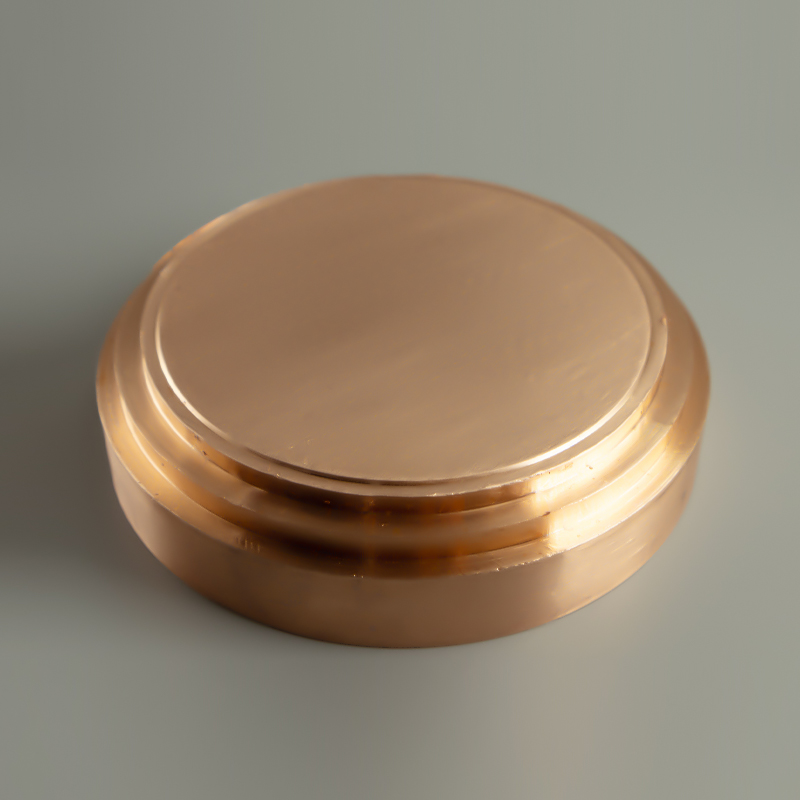 Copper targetPurity: 99.999-99.9999% Maximum Size: Customizable Maximum Weight: Customizable Packaging: Wooden crate, double-layer vacuum packaging, inner cushioning material (PEF)...View Product →
Copper behaves in the opposite direction. A few hundredths of a percent of phosphorus pulls electrical conductivity down by a double-digit percentage, which is why oxygen-free grades are written into conductor and sputtering target specifications even at a painful price premium. In nickel and nickel alloys, sulphur and other low-melting impurities concentrate at grain boundaries and cause cracking during welding or heat treatment.
This is why the upstream steps matter more than any single test. Purification, melting, casting and subsequent processing set the interstitial and impurity levels, and a certificate issued per heat is what lets a buyer trace those levels to the specific target, bar or coil that arrives at the dock.
Alloy Properties in Service: Ti-6Al-4V
Ti-6Al-4V, also called TC4, is the most widely used titanium alloy, and its composition explains the property profile almost completely: about 6% aluminium, 4% vanadium, balance titanium, plus tightly controlled interstitials.
- Titanium (Ti), balance, about 90%
- Aluminium (Al), 6%
- Vanadium (V), 4%
Typical composition of Ti-6Al-4V by weight, excluding interstitial limits.
Aluminium stabilises the alpha phase and raises high-temperature strength while keeping density low. Vanadium stabilises the beta phase and improves room-temperature ductility and response to heat treatment. Shift the balance and you shift the service window.
The extra-low-interstitial version keeps oxygen at or below 0.13% by weight instead of the standard 0.20%. Tensile strength falls slightly; fracture toughness and fatigue crack growth resistance improve. Aerospace and implant buyers pay for that trade deliberately, and it is one of the clearest examples of purity setting alloy properties.
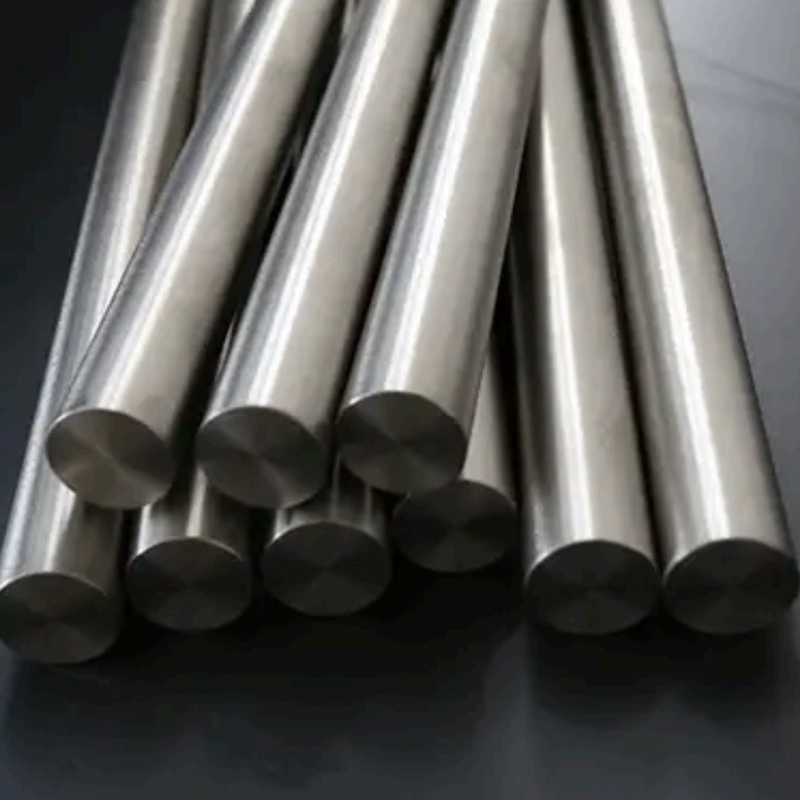 TC4 ELIMaximum size: Customizable Maximum weight: Customizable Packaged in wooden crates with sealed bags insideView Product →
The pattern repeats across sectors. Semiconductor and display manufacturing want low interstitial content for target purity and uniform film composition. Aerospace wants strength retention at temperature together with damage tolerance. Medical devices want predictable corrosion behaviour and ion release. The material families used in each of those sectors are grouped on the industries page.
Frequently Asked Questions
Do alloyed materials always outperform pure metals?
No. Conductivity is the clearest counter-example, since dissolved elements scatter electrons, and corrosion behaviour can go either way depending on the medium. There are also cases where the unalloyed metal is the better engineering choice, which is why the comparison between pure nickel and nickel alloys is worth making before a grade is frozen.
Can two heats of the same alloy have different properties?
Yes, and quite easily. Grain size, cooling rate, inclusion content and interstitial level all vary between heats, even when the chemical analysis stays inside the same specification window. That is why per-heat certification and incoming verification testing exist.
What is the difference between alloy properties and temper?
Temper or condition describes the processing state of the material, while properties are the measured result. The same alloy supplied in two tempers behaves as two different engineering materials, so both must appear on the drawing and on the order.
If you are specifying high-purity titanium, nickel, copper, niobium, cobalt or a titanium alloy for a demanding application, send the grade, condition and impurity limits. We will confirm what can be delivered and what the certificate will show.