English
High Purity Materials: Why Grade Numbers Hide Real Buying and Process Risks
Content
- 1 What the Grade on a Certificate Actually Measures
- 2 The Refining Route Explains What the Number Cannot
- 3 Where High Purity Materials Change the Outcome
- 4 The Purity–Cost Tradeoff: When a Higher Grade Is Wasteful
- 5 Form Factor Decides Which Specification You Actually Sign
- 6 How to Qualify a Supplier Without Losing Six Months
- 7 Frequently Asked Questions
Two suppliers quote the same grade — 99.99%, 4N, same weight, similar lead time — and the material behaves differently in your process. One target sputters a film with stable resistivity for the whole campaign. The other drifts after thirty wafers, and the root cause turns out to be 12 ppm of an element that never appeared on the certificate.
That gap is the whole subject. The short version: purity is a chemistry statement plus a process statement. The number tells you what refining removed; the refining route, the form factor, and the full impurity list tell you whether the material will survive your process. Buyers who compare only the headline percentage are comparing the cheapest part of the specification.
What the Grade on a Certificate Actually Measures
Purity grades are shorthand for a total impurity budget, not for individual limits. 3N means 99.9% — up to 1,000 ppm of everything else. 4N leaves 100 ppm, 5N leaves 10 ppm. That budget is shared across dozens of elements, and how it is spent matters as much as its size.
The total budget hides the elements that hurt
A 5N certificate that permits 8 ppm sodium is not automatically better than a 4N5 lot holding 0.5 ppm sodium, if sodium is the element degrading your interface. What you want is an element-by-element table with detection limits stated, usually from GDMS or ICP-MS. Ask which elements were not reported — a 30-element table on a 70-element chart leaves room for surprises.
Interstitials are usually missing from the metal list
Oxygen, nitrogen, carbon, hydrogen and sulfur change hardness, ductility, sputter behavior and corrosion resistance, yet they are measured by different methods — inert gas fusion, combustion analysis — and printed on a separate line, or not printed at all. For titanium, tantalum and niobium, ask explicitly rather than assume.
Purity is not cleanliness
Inclusions, second-phase particles and surface contamination can ruin a target or an implant even when the chemistry reads 4N5. Particle counts, inclusion ratings and finishing records belong in the same conversation as the assay.
The Refining Route Explains What the Number Cannot
Different purification technologies remove different families of impurities, so the same nominal grade can carry very different residual profiles.
- Electrolysis strips most metallic impurities efficiently and yields high-purity crystal, but brings electrolyte residues such as chlorides and organics, plus elevated hydrogen that needs vacuum or thermal treatment.
- Vacuum and electron-beam melting handle volatile metals and dissolved gases well, and are weak against refractory elements like tungsten, tantalum or molybdenum; loose melt practice also risks crucible pickup.
- Zone refining separates by segregation coefficient, so it excels on some elements and barely moves others.
- Iodide and hydride routes give very clean titanium on the metal side, then powder handling reintroduces oxygen afterwards.
The practical consequence: for a deposition target, the question is not only "which grade" but "which grade, from which route, with which measured list". Heat history and packaging matter too — a 6N ingot sliced and packed without atmosphere control loses its advantage at the last step.
Suppliers who keep purification and downstream forming inside one chain have fewer handoff points where contamination creeps back in. A high-purity titanium crystal produced, remelted and finished under one quality system is checkable in a way a trading-house certificate never is.
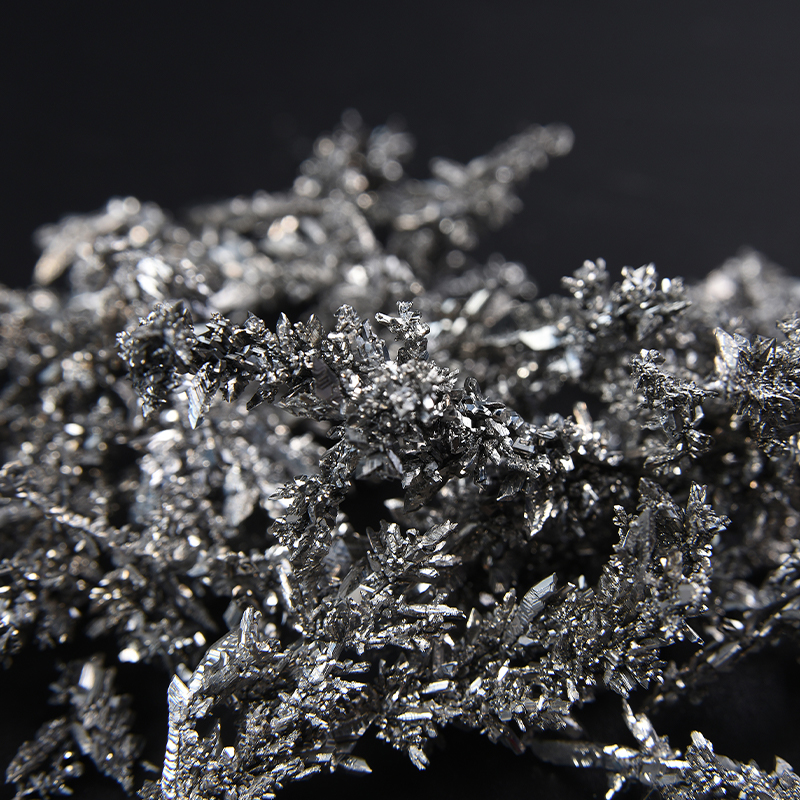 High-Purity Single-Crystal Titanium for Semiconductor and Aerospace UseSingle-crystal titanium with 4N8–4N9 purity, relevant where contamination control and structural integrity affect semiconductor targets or aerospace research.View Product →
Where High Purity Materials Change the Outcome
Purity requirements cluster by failure mode rather than by industry label. The same 4N5 lot can be generous in one application and marginal in another.
Semiconductor and thin-film deposition
In sputtering and evaporation, trace metals and interstitials shift film resistivity, stress and step coverage. Sodium and potassium migrate; oxygen and carbon influence nucleation. Target microstructure — grain size, texture, bond quality — often drives particle generation more than the assay does.
 High-Purity Copper Sputtering Targets for PVD Thin Films5N–6N copper targets for magnetron and ion beam sputtering, with customizable dimensions and vacuum packaging for semiconductor, display, and optical coating workflows.View Product →
Aerospace and high-temperature engineering
Refractory metals and their alloys carry load where nickel alloys creep. Interstitial oxygen and nitrogen can raise strength while cutting ductility and fatigue life, so the interstitial line deserves more attention than the total metallic impurity figure.
 High-Purity Niobium Ingots for Superalloys and Semiconductor Equipment4N niobium ingots up to 400 mm diameter and 2 t, suited to sputtering targets, crystal-growth components, and alloy melting requiring high-temperature and corrosion resistance.View Product →
Biomedical
Implants and instruments combine corrosion resistance with leachable limits; the specification usually joins chemistry to surface finish and microstructure, and the qualification file is larger than the certificate.
Display, solar and new energy
Large-area coatings are sensitive to target density and uniformity. A handful of inclusions produces arcing and repeating defects across a panel, which is why density and porosity get written into the order.
The Purity–Cost Tradeoff: When a Higher Grade Is Wasteful
Overbuying is common because the grade is the easiest line to compare. Refining cost rises steeply with each additional nine, so the sensible move is to specify the lowest tier that your own data shows is sufficient.
| Grade | Impurity budget | Typical use | Risk of mis-specifying |
|---|---|---|---|
| 3N (99.9%) | Up to 1,000 ppm | Decorative and functional coatings, master alloys, general metallurgy | Below: visible film defects. Above: budget spent on properties the process never uses. |
| 4N (99.99%) | Up to 100 ppm | Evaporation sources, industrial thin films, many instrument components | Often the cost-efficient tier; buying 5N here rarely shows up in yield data. |
| 4N5–5N | 32–10 ppm | Sputter targets for semiconductor metallization, optical coatings, critical aerospace parts | Below: yield loss that appears weeks later. Above: justified only with measured sensitivity. |
| 5N5–6N | 3 ppm and lower | Advanced nodes, III-V and optoelectronic devices, research work | Below: device-level failure. Above: defensible only where the interface genuinely demands it. |
Form Factor Decides Which Specification You Actually Sign
Chemistry is roughly half the purchase order. The rest is shape, microstructure and handling, and those tolerances never appear on a purity certificate.
- Crystal and ingot: segregation at the hot top, shrinkage porosity, and a surface oxide layer. Ask about discard practice and ultrasonic testing.
- Plate, sheet and rod: dimensional tolerance, flatness, straightness, and how much material disappears in machining.
- Tube: concentricity and wall tolerance matter for anything fluid-carrying or jacketed.
- Powder and particle: size distribution, morphology and oxygen pickup — every handling step adds oxygen.
- Target: grain size, texture, bonding, backing plate and end-of-life thickness all affect cost per wafer.
- Alloy, such as TC4 ELI: the extra-low interstitial variant is controlled by element balance rather than a single purity figure.
Two suppliers can meet the same assay and still deliver different products, because the shape carries its own tolerances and its own qualification path.
How to Qualify a Supplier Without Losing Six Months
- Start with the quality system, then look past it. ISO 9001 and IATF 16949 are baseline expectations rather than differentiators; ask what happens to a lot that fails an in-process check.
- Request a lot-level certificate stating method and detection limits, and pay for one third-party GDMS check on a real sample. Compare the two documents.
- Ask about the chain, not just the plant. Purification, melting, casting and machining under one roof cut handoff contamination and shorten the loop when a specification needs adjusting.
- Agree acceptance criteria before the trial: which elements, which limits, which microstructure numbers, which sampling plan.
- Clarify commercial terms early — minimum quantity for a qualification sample, re-melt lead time, and tolerance for lot-to-lot variation.
- Reserve capacity. High-purity capacity is finite; the tier you can buy in a trial is not always the tier available in volume next quarter.
On that last point, scale and continuity matter. Ningbo Chuangrun New Materials has refined ultra-high-purity metals since 2012 across five production bases in China, runs ISO 9001 and IATF 16949 systems with an in-house purity testing service, and supplies forms ranging from electrolytic crystals and sponge to ingots, plates, tubes, rods and targets. If you are still comparing options, send your specification for a purity check before the design freezes.
Frequently Asked Questions
Is 99.99% the same as 4N?
Yes. 4N is shorthand for four nines. 4N5 means 99.995%, and 5N means 99.999%. The naming is convenient but says nothing about which elements remain.
Does a higher grade always perform better?
No. Grade is a total budget. If the specific element that damages your process sits well below the limit, a lower tier at a lower price can deliver identical results.
Which documents should accompany a shipment?
A lot certificate with test methods and detection limits, traceability from melt number to finished form, and separate interstitial results. For critical parts, add a third-party analysis on a sample you selected yourself.
How do purity and cleanliness differ?
Purity describes chemical composition. Cleanliness describes inclusions, particles, porosity and surface condition. A deposition target or an implant can fail on the second while passing the first.
Can small quantities be supplied for qualification?
Often, yes, but confirm it before you design around the material. Trial quantities and production quantities do not always come from the same process route.
The buying decision in one line: choose the lowest grade that your own measurements justify, then spend the difference on refining route, form factor and lot-to-lot consistency. That combination — not the extra nine — is what keeps a production line running.